"It's Not
Just A Bike, It's An Old Trek*"
Introduction
|

Trek craftsmen Mike Appel
(left) and Dick Nolan. This photo (©Trek) appeared in Trek
brochures from 1976 through 1981. (Click to enlarge.)
|
Welcome to the unofficial Vintage-Trek* bicycle web
site. This is a noncommercial, just-for-fun, hobbyist site.
The primary purpose of this site is to gather and disseminate
information about early lugged, steel-framed road bikes made
by the Trek Bicycle
Corporation, Waterloo, Wisconsin. In response to popular demand,
the site has expanded to include not-so-vintage Trek bikes of all kinds
as new as 2012.
Mountain bikers, and carbon and aluminum
aficionados do not despair - the brochure extracts on the site contain
a list of specs for all of the bikes Trek produced in that year. Additionally,
the table of Trek models
by year includes all Trek bikes through 2005.
Other Resources - Specs for all Treks 93 and
newer are on the BikePedia.com
site. Additionally, specifications and pictures for 2003 and newer Treks
are available on the Trekbikes.com
web site archives.)
Before this site began, in various bicycle-related Internet
discussion forums there were posted questions like:
- How old is my Trek?
- How was it equipped when new?
- What was the original selling price?
- Where was it in the price/quality hierarchy?
The query usually went unanswered. This site is an attempt
to provide the information that answers questions such as these.
What Is on This
Page?
Introduction
| On This Site | Is
it a Trek?
Determining Year and Model
| Collectability
| Contributors
Comments Appreciated |
Contact | About this Site
| My Treks
 |
|
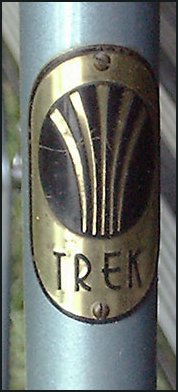
Trek 1978
TX900 headbadge. Photo courtesy Chas. Porter
|
What
Is on This Site?
On this site are Trek
brochures or catalogs covering the period 1976 to 2012. There
also are four early price
lists from bike shops in Santa Barbara, CA. The
price list and values page also has a list of bike prices when new.
This information was provided mostly by visitors to this site. This
page also includes suggestions for estimating the current value of a
Vintage Trek.
There is a timeline
for steel Trek road bikes that often can be used to identify or date
a frame. A table of Trek
models by year and color includes virtually all Trek bikes from
1976 through 2005.
Serial number information can be found on the serial
number page.
Methods of determining the date of manufacture of bicycle
components (and often the bikes they are on) are described here.
NOTICE:
We are trying to sort out NITTO manufacturer's date codes.
See here
for details.
Suggestions
for buying or selling a vintage Trek are given on the site as well
as tips for refurbishing or
upgrading your bike. Included is a section on general specifications
for vintage Treks.
There also are catalogs from Gary
Fisher (1988-2010); Klein (1989-2008), and LeMond (1996-2008) on
the site.
Is
It a Trek?
It usually is easy to identify a bike frame as a Trek,
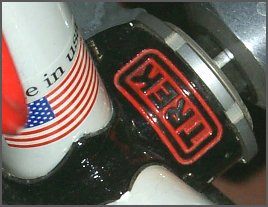
even if it has been repainted, as virtually all of them have "TREK"
conveniently stamped or cast into one or more places on the frame. Possible
locations are the top of the seat stays, the seat lug, the bottom bracket,
and the top of the fork crown. An exception is the TX900 which has no
cast-in "TREK".
Determining
the Year and Model of Your Steel Trek
One often has to be a bit of a detective to sort this
out.
For Year:
- If you know the model number, compare the colors
of your bike against the Models/Years/Color
listing. This works only for Treks from about 1982 onward. The earlier
bikes models were available in numerous colors.
- Check the serial number of the frame. If a 7 character
alphanumeric, see the results of the Serial
Number Decoding Project. If it is 6 digit numeric, in the range
000000 to 270975, go to the serial
number page to get the year and model number. If it is 6 digit
numeric higher than 270975, the year may be able to be determined
from the Table II on the serial number page. Other serial number formats
are described on the serial
number page.
- Check the description of graphics by year in the
timeline to match
up your bike. Go to the brochures,
the BikePedia.com
web site (for 1993 and newer), the Trekbikes.com
web site archives (for 2003 and newer) and perhaps the gallery
for more detail. For most years, (generally 1981 and newer) color
is telling. For many models, two or more colors were available, but
only one color is pictured. The other is listed on the model description
page or in the separate specifications table. Complicating bike identification
by color, Trek occasionally added a bike color after the brochure
for that year was made. As they are identified, these additional colors
are included in the
Models/Year/Colors page. If your frame has been repainted, you
may be able to find the original paint inside the bottom bracket shell,
seat tube, or head tube. Occasionally, a frame was returned to Trek
for repainting. Trek would use the then current colors and graphics,
not the original ones. This means that color and graphics can (rarely)
be misleading as to year.
- If your bike has a model name or model number, look
it up on the Models/Year/Colors
table to find the years your bike was sold.
- Compare the components on the bike with those described
in the brochures, if you think they may be original. (BTW - This is
tedious.) Cranks and brakes (and often seatposts), are more likely
to be original than other components.
(Note: Trek occasionally changed the components from what were described
in the brochures. Improved parts became available during the year
or specified parts became unavailable. In the case of unavailable
parts, Trek invariably substituted better parts.)
- Date the components on the bike (if you think they
are original), guided by the component
dates page. Dated components most likely to be original are brakes,
handlebars, cranks and seatposts.
For Model:
- For some years, the model number (in the form xxx)
appears on the bike. Easy - even I often get this right.
- If the serial number is a 7 character alphanumeric,
see the results of the Serial
Number Decoding Project. If the number is a 6 digit numeral, check
to see if your serial number is listed on one of the serial
number years.
- Racing? Touring? Sport? Measure the chainstay length,
from the center of the crank to the center of the rear dropout. A
length of 43.5, 44, 44.5, up to 47 cm (the Model 720 and 85 620) typically
is a touring model, racing models are shorter at 41 to 41.5 cm or
so. Sport versions are somewhere in between, at 43 cm or so.
- Compare the components on the bike (and frame colors
on 81 and newer) with those described in the brochures.
or in the descriptions on the BikePedia.com
(93 and newer) or the Trekbikes.com
web site archives (for 2003 and newer) web sites.
- For many models, two colors were available, but only
one color is pictured. The other is listed on the model description
page or in the separate specifications table.
- Eyelets on dropouts? (for fenders or racks) - typically
none on racing models (except for the first 4 or so years), yes on
touring models, yes on most sport models.
- Rear derailleur cable routed above or below bottom
bracket? See 1982 Timeline
page entry.
- Rear derailleur cable routed through right chainstay?
See 1985, 86, 87 Timeline
page entries.
- Cantilever Brakes? = Touring model. Centerpull Brakes
= Touring (early 1982 720/728). Sidepull brakes? Very common. These
only rule out models with cantilever and centerpull brakes.
- Fastback seatstays with no TREK stamped on seat lug
=TX900. (See Chas.
Porter's bike in the gallery.) Also, the TX900 has three holes,
of increasing size, in the top of the seat lugs and head lugs.
- A seatpost diameter of 27.4mm indicates a Model 170.
The Model TX300 is 26.8mm. All other vintage Treks are 27.2mm.
- See Is
it Columbus Tubing?
Collectability
of Steel Treks
People often ask about the collectability of old Treks.
Here are some general comments from my own observations and from the
collected experience of others.
- Lots of steel Trek bikes were made; most are not rare. However,
virtually all steel Treks are quality riders and are valued as such.
Vintage Treks with upgraded components are more valuable as riders,
but this can decrease the value as a collector's item.
- Top level Treks are considerably more collectable
than lower level bikes. However, keep in mind that an entry-level
Trek is at a mid-level price/value in comparison to the offerings
of most other manufacturers.
- Earlier Treks are more valuable as they generally
are more rare. Now that the serial numbers are generally understood,
one can verify the age of the frame.
- Condition is all important to collectability. A bike
with original paint is more desirable (to a collector) than a repainted
bike. Additionally, bikes with components as provided by the factory
are more desirable to the collector. In the case of bikes originally
bought as bare frames, the components should be period correct.
- The early bikes were built with traditional frame
building methods and therefore are more desirable to the collector
(in my view). This change from traditional methods to more automated
methods was fairly gradual from 1976 to 1980, but then increased.
Cast one-piece head tube/head lug assemblies appeared on some bikes
in 1980 or 81. This began with lower level bikes but extended to mid
level bikes later. (A small picture of this headtube/lug device is
on page 2 of the 89
catalog.) Cast seat lugs, with sockets for the stays, appeared
in about 1984. Artisan frame builders were generally replaced with
frame technicians in the early 80s as more automated techniques were
developed and employed. These changes did not necessarily reduce the
quality of the frames, but did move Trek farther from traditional
methods. This did achieve the goal of reducing production costs and
helped keep Trek cost competitive (and solvent) in a highly competitive
environment.
- Vintage Trek bikes do not (yet) have the cachet of
some English or European bikes, which generally have a much longer
history. However, during the Vintage-Trek period, the
quality of the frame materials, construction methods, and finish are
certainly equal or superior to the vast majority of English and European
top-level production bikes, and exceed many custom bikes as well.
- The early Trek bikes, up to about 1983, have fender
clearance. (The touring bikes beyond 83 all have fender clearance.)
If people want a proper wide-tired touring bike, winter bike, or rain
bike, all with fender clearance, they must typically buy a modern
cyclocross bike or a custom bike. Most other modern road bikes don’t
have the clearance (and don't have lugs). This helps keep vintage
Treks popular as riders.
- The early bikes, 1976 to about 82, were built using
sliver solder, a more costly and desirable method. Many later models
were built, at least partially, with sliver as well.
- Ishiwata 022 steel frames were less expensive than
Reynolds- or Columbus-tubed frames, but the steel quality was equal
to the others. They are often described as “best value”.
Some vintage frame or bike models have special significance;
these include the TX900, 720/728, 170, and 520.
The TX900 was the early top-of-the-line frameset,
dating from 1976 to mid 1978. The Columbus tubing, racing geometry,
and fastback seat stays were characteristic of this model (not to be
confused with the later bikes from the mid-80s having cast socketed
seat lugs in fastback form). Another special feature is the three holes,
of increasing size, in the top of the seat lugs and head lugs. The unique
and distinctive design, and relative rarity, adds to the value of these
frames.
The 720/728 touring bikes, dating from 82-85
were (and still are) highly-rated bikes for serious touring. The long
chainstays, 47cm, provide heel clearance for the rear panniers, and
contribute to a comfortable ride. These frames and bikes are still highly
sought after by knowledgeable tourists. A similar steel lugged frame
is not currently available except from a custom framemaker. In my opinion,
these framesets and bikes will only increase in value over time. The
steel racing Treks will never again be used by top racers for racing.
However, the 720 will be used (and coveted) by experienced tourists
well into the future. Trek made a total of 7929 720 and 728 bikes and
frames (number calculated by Mitch Hawker).
(Note: Trek ran out of model numbers; don't confuse
these touring 720s with the 1990-1999 Model 720 MultiTrack bikes.)
The Model 170, arguably Trek’s best steel
racing frame, was available during the period 1983 to 1985. They were
made with Reynolds 753 tubing. Among their users was the 7-11 Team.
Tim Isaac designed the 170. Expert framebuilders John Thompson, Rick Faultersack, and Kelly Gamble built them.
The 520 touring bike first appeared in 1983 and
probably has made more trans-America crossings than any other bike model.
It still is offered by Trek in steel (although not lugged), which has
helped maintain significant model recognition among bicyclists. This
longevity and popularity has raised the value of this bike over similarly-priced
vintage Treks of the period.
Two parameters are specially important to the 520 over
the years: chainstay length (as pointed out by Robert Cooke) and the
type of brakes used. Long chainstays are used on touring bikes to provide
a more stable, cushioned ride and to provide more room for panniers
(saddle bags). Serious touring bikes in the 80s and 90s were equipped
with cantilever brakes (the classic center-pull cantilevers). These
were considered powerful enough to stop a heavily loaded bike going
downhill. The sidepull brakes of the time were considered less capable
for such extreme duty. It wasn't until Shimano developed their "V-brake"
(known generically as the side-pull cantilever or the direct pull brake)
that a viable alternative to the traditional cantilever was available.
This new brake was used on the 520 after 1999. The table below shows
these two 520 characteristics through time. These data should be of
use to people who plan to buy a vintage 520.
Table I - Brake Type and Chainstay
Length for Trek Model 520 from 1983 through 2012
|
Year
|
Designation
Used by Trek
|
Brake Type
|
Chainstay
Length, cm
|
|
1983
|
Touring
|
Sidepull
|
43
|
|
1984
|
Touring
|
Cantilever
|
45.5
|
|
1985
|
Sport Touring
|
Sidepull
|
42.5
|
|
1986
|
Sport Touring
|
Sidepull
|
42.5
|
|
1987
|
Touring
|
Cantilever
|
45.5
|
|
1988
|
Touring
|
Cantilever
|
45.5
|
|
1989
|
Touring
|
Cantilever
|
45.5
|
|
1990
|
Touring
|
Cantilever
|
43
|
|
1991
|
Touring
|
Cantilever
|
43
|
|
1992
|
Touring
|
Cantilever
|
43
|
|
1993
|
Touring
|
Cantilever
|
43
|
|
1994
|
Touring
|
Cantilever
|
45
|
|
1995
|
Touring
|
Cantilever
|
45
|
|
1996
|
Touring
|
Cantilever
|
45
|
|
1997
|
Touring
|
Cantilever
|
45
|
|
1998
|
Touring
|
Cantilever
|
45
|
|
1999
|
Touring
|
V-brake
|
45
|
|
2000 - 2012
|
Touring
|
V-brake
|
45
|
The 620 touring bike was offered in 1983, 84,
and 85. It was a level above the 520, but because it was short lived
and no longer in production, it is not as familiar to potential purchasers.
On the used market, this often means less money for an even better bike.
Only the 85 model had the extra-long 47cm chainstays, matching those
of the 720.
Some Trek models shared the same frame. For example,
if you want a 1983 frame with 620 geometry and materials, you can look
for a 1983 600, 630, or 640, all of which have the same characteristics
as the 620. The geometry and frame materials are normally given in the
brochure for that year.
Contributors
|
|
|
1984 Model 770 with custom paint.
Picture provided by Wayne Bingham.
|
Many thanks to the people who have contributed significant
information to the site. They are: Tom Adams, , Mark Agree, Don Allgire, Peter Berger,
Wayne Bingham, Alan Burnett, Larry Black, Dave Breitlow, Ed Brown, Colin
Campbell, Dan Carlsson, Mark Carter, Andrew Chadwick, Chris Clement,
Bill Clements, Chris Cleveland, John Colt, Nels Cone, Robert Cooke,
Mark Crabtree, Julia DeGrace, Kris Echert, Taryn Echert, Anita Edens,
Dave Evans, David Feldman, Ivan Feldman, Erik Frey, Tim Fricker, Cory
Fry, Rich Ferguson, Marsha Gill, Don Gillies, Dickey Greer, John Hallows,
Lyle Hanson, D. Hansen, Keith Hatfull, Mitch Hawker, Sean Hickey, George
Hoechst, Bill Howard, Jim Jack, Jennings Kilgore, Michael Johnson, John
Keller, Steve Kurt, Jeff Kwapil, JP Lacy, Kevin Maher, Dave Mann, Steve
Mann, Tom Marshall (T-mar), Tom Meara, Michael McCullough, Marty Meison,
Lou Miranda, Dale Mizer, Greg Mooncalf, Mike Marro, Kirt Murray, George
Nenni, Larry Osborn, Dennis Pieper, Andy Poplawski, Chas. Porter, Tim
Rangitsch, Jack Romaine, Michael A. Roberts, Brandon Rouse, Roger Sacilotto, John Satory,
Paul Schleck, Travis Sherwood, Dan Shindelar, Bruce Squires, Dave Staublin,
Jay St. John, Scott Stulken, Tom Sustarich, Mike Swantak, David Temple,
Elisabeth Thomas-Matej, Kevin Tita, Craig Tornga, Kevin Truelove, Mark
Wade, Martin Walsh, Leighton Walter, Ben Weiner, Luker White, and Brad
Ziegler.
This site would not have been possible without their
help and support. I know there will be more to thank in the future.
The list above does not include the many hundreds of
other people who have provided a serial number or other smaller contribution
to the site. Our hearfelt thanks to these folks as well.
Comments
and Information Appreciated
Please send your comments, corrections,
and materials! If you have additional information about steel Treks;
old brochures, price sheets, or other information, please pass them
along. Easiest digital form is probably as .gif files (for graphics)
or .jpg files (for photographs) scanned at 150 dpi or more. If you send
printed information, it will be scanned and returned to you.
Currently, I am not adding more photos to the Gallery.
Now that we have all (or virtually all) of the brochures/catalogs for
each year, the Gallery is not as important as it was earlier. My current
task is to sort out the many other forms of serial numbers used on Trek
bikes throughout the years.
How
to Contact Me
Skip Echert - E-mail: skip@skipechert.com
About This Site
At a bicycle shop in Santa Barbara, in about 1978, I
picked up a Trek brochure which described the "pre owned"
frame/bike that I had just purchased. In 2001, I found that brochure
in my old papers and was surprised to find two other Trek brochures
and four price lists that I had salted away as well. These materials
were the genesis of this site, which went online in 2001. The amount
of material on the site has grown steadily over time, much of it from
the information and documents generously provided by site visitors.
As the site expanded, and visitors could find information
to answer their questions, the nature of the questions has evolved.
For example, I now get few questions about the early serial numbers
(as they now are well documented) but more about the many later ones
used by Trek.
The site currently gets 12,000 to 20,000 unique visitors
per month. We have received and replied to over 2400 emails. Many of
the questions asked and then researched have been the basis for information
added to the site.
My Treks
I have a Trek TX900, originally sold new (frame only)
in 1977 to a very accomplished teenager who raced it in and around Santa
Barbara, CA. He had equipped it mostly with Campagnolo Nuovo Record
parts from 1973 and earlier, a Zeus front hub, a Super Olimpic rear
hub, and Cinelli bars and stem. He, or the previous owner, had replaced
many of the steel bolts in the components with titanium or aluminum
after-market items. I purchased it from him in 1978 for the sum of $375.
He was 16 when he sold it, after discovering girls and cars.
A few years ago, I replaced the sew-up rims with clinchers,
carefully spread the rear triangle to 126mm and replaced the (then)
splitting rear hub with a 6 speed Campagnolo model. At the urging of
Don Altman, a bike-savvy friend, I replaced the the Teledyne titanium
crank axle (by the way - beautifully crafted) with a stock Campagnolo
model. Don knew that many of these aftermarket axles had failed - with
painful consequences for the rider. (I was probably perfectly safe,
as my horsepower output could never be described as "gear busting").
After making this substitution, I realized the axle had been the cause
of wobble in the chainrings. With these changes, the bike now is even
a greater joy to ride. Perhaps one day the TX900 will have matching
rims, tires, hubs, and brake pads. (Or would that just indicate a lack
of imagination on my part?)
In 2002, I bought a 1981 Model 613, in almost new condition,
at Recycled
Cycles in Seattle. I decided this would be my (almost) modern bike.
It is now a 24-speed index shifter, assembled from used and new parts.
See this gallery page
for details.
In June of 09, John Keller, a major contributor to the
site, gave me a 1980 Model 710 frame in excellent condition.
Wow! The results of the buildup can be seen on a
page in the gallery.
I received the fabulous gift of a 1985 Model 720 frameset in April of 2014. It was from numerous members of the BikeForums.net Classic and Vintage forum. It was offered as a thank you for the Vintage-Trek website. What generous people! Earlier, in corresponding with Dave Vegafria about his 720s, I casually mentioned my long-term hope of getting a 720 one day. Without mentioning anything to me, Dave thought the time could be sooner. He posed the question on the forum and got dozens of offers of support. Since it arrived, I have gathered almost all of the needed components. When finished, it will be in the gallery.
My son has a 1993 Model 8700 Trek carbon-tubed mountain
bike. He bought it at a local pawn shop for $100 in 2004. It had been
updated with an early suspension fork.
Introduction
| On This Site | Identify
as a Trek | Determining
Year and Model | Collectability
Contributors | Comments
Appreciated | Contact |
About this Site |
My Treks
Brochures
| Price Lists and Values
| Trek History |
Trek Timeline |
Serial Numbers
Component Dates
| Gallery |
Contact | Buy/Sell Suggestions
Refurbish/Upgrade |
Bike Resources
| Home
*Trek is a trademark
of Trek Bicycle Corporation, Waterloo, WI
All copyrights in
the TREK brochures, pricelists, owner's manuals and photographs displayed
on this website are the sole property of Trek Bicycle Corporation, Waterloo,
Wisconsin.
All materials in
this site not copyrighted by others are Copyright © 2001-2015 Skip
Echert Web Associates, All rights reserved.